The Data Center Construction Slowdown Could Become Your Next Business Problem
One of the country's most energy-rich states just told new data center development: not so fast.
Texas has paused new state-issued permits for data centers while regulators look at the impact on power, water, infrastructure costs, and other resources. More than 470 gigawatts of proposed projects are reportedly seeking connections to the Texas grid — more than five times the state's peak demand. (reuters.com)
It's easy to call this a Texas power problem.
It isn't.
It's a warning about what happens when technology expands faster than the systems and communities needed to support it.
The Technology May Be Ready. Everything Else May Not Be.
AI has accelerated demand for computing power faster than most organizations expected. But a data center can't function on processors and software alone. It also needs electricity, water, cooling, connections to the grid, land, permits — and public acceptance.
Fort Worth, for example, imposed a temporary moratorium after residents raised concerns about water use, noise, and the impact on surrounding areas. In Hopkinsville, Kentucky, residents raised concerns about noise, water consumption, backup generators, emissions, nearby homes, and waterways around another proposed facility. (datacenterdynamics.com) (datacenterdynamics.com)
The details vary from one community to another, but the pattern doesn't: local opposition can change a project's schedule, requirements, or even whether it moves forward.
Community resistance isn't the only thing slowing projects down. Grid connection delays, equipment shortages, and long lead times can push schedules well beyond what the original roadmap assumed. That's one reason investors are paying more attention to "time to power" — when the electricity a project needs will actually be available. (reuters.com)
Put those pressures together, and the lesson has very little to do with whether your organization owns a data center.
The Risk Is in the Assumptions
Most companies don't build the infrastructure they rely on. Their cloud platforms, AI services, and critical vendors depend on facilities, utilities, equipment, regulators, and communities that may be several layers removed from the business.
That distance can create a false sense of certainty.
A project plan might say capacity will be available in June. A vendor may promise expansion into a particular region. But there's an important difference between something planned, something requested, and something actually committed.
Executives can't eliminate those outside dependencies. They can find out how exposed the business is if one of them changes.
Where to Start
Before approving an initiative with significant external dependencies:
Quantify what power, water, connectivity, and other capacity the plan actually requires.
Verify what is contractually secured, and flag what is still a forecast or assumption.
Model what changes if a critical approval, connection, facility, or piece of equipment is delayed by six, twelve, or twenty-four months.
Assess whether noise, water use or quality, utility costs, emissions, or land use could affect the schedule.
Calculate the cost of delay in revenue, productivity, capacity, carrying costs, or committed capital.
Identify a backup if the preferred provider, location, or infrastructure can't deliver.
The goal isn't to predict every obstacle. It's to identify the assumptions that could change the economics or schedule before too much money and time are already committed.
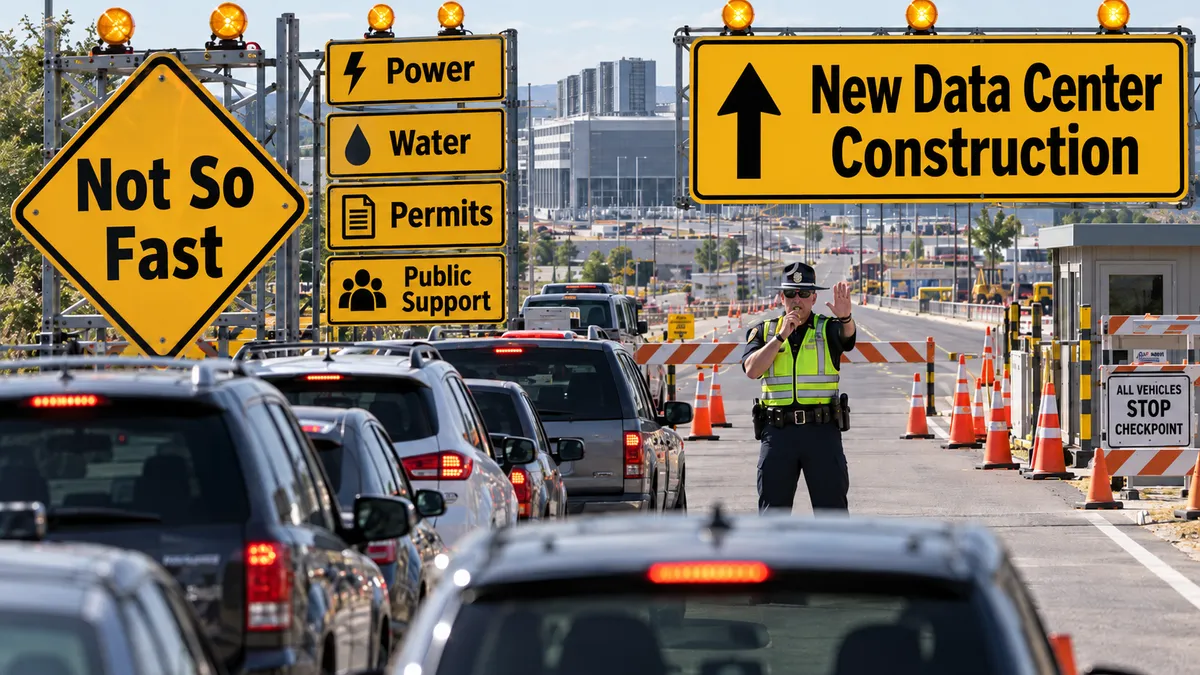
The road to more computing capacity isn't closed.
The traffic cop is there for a reason.
Not so fast. Check the requirements first.
If you're not sure which outside dependencies could affect your technology plans, a focused 15-minute review can help surface them before they become costly surprises.