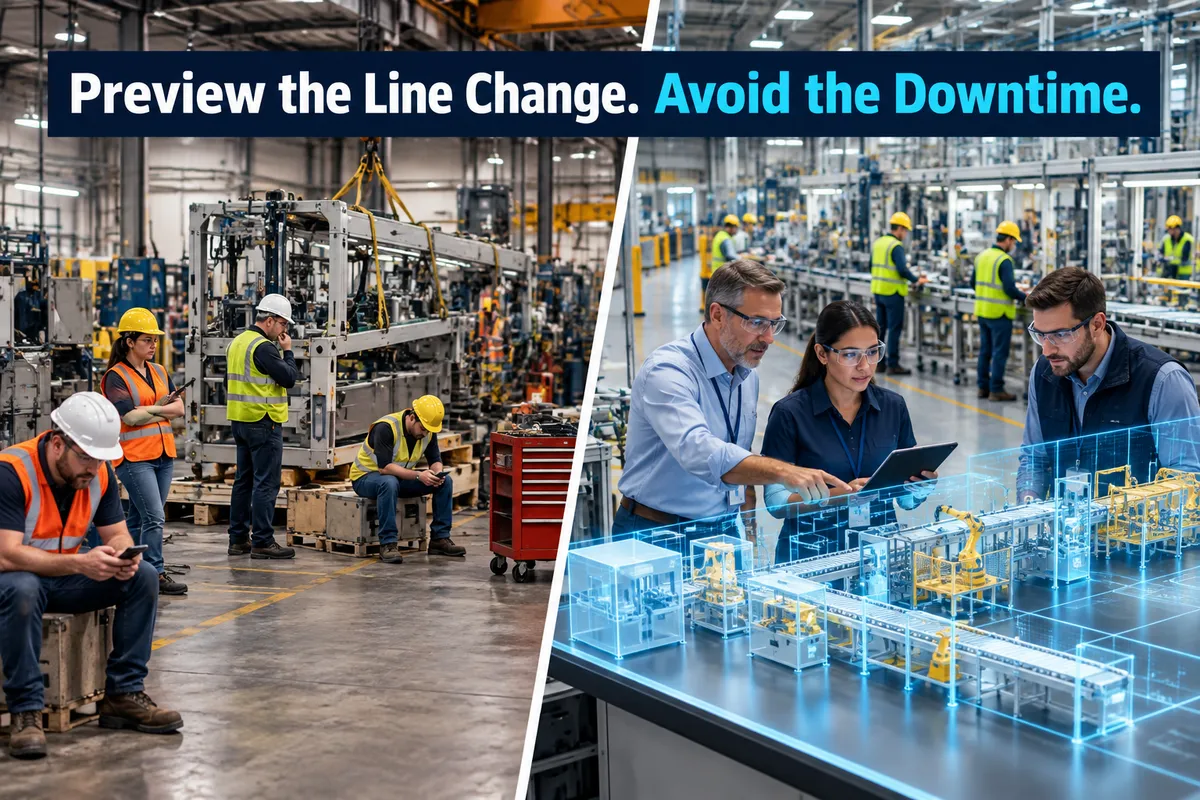
What If You Could See the Breakdown Coming?
The most expensive time to discover that a production-line change doesn’t work is after the equipment has moved, the line has slowed or stopped, and people are standing around waiting.
That is still how many operational changes are effectively tested.
Higher costs come from downtime, lost output, rework, delayed capacity, idle labor, and, at times, a second set of changes needed to correct what the first set produced.
What are you doing to test your line changes today?
Before you alter a production line, think about how much your team can actually see in advance.
Are you basing your decision on CAD drawings, spreadsheets, engineering judgment, previous experience, physical pilots, or limited simulation?
None of those methods is inherently wrong. The real issue is whether they show enough about the downstream effects before the operation absorbs the risk.
The harder it is to anticipate those interactions, the more likely the production floor becomes the place where assumptions are tested — at full cost.
What if you could test more of the change first?
This is where digital twins, simulation, and XR/MR begin to matter.
A digital twin is a virtual version of a physical asset, process, or environment. Simulation enables teams to ask “what if?” and model potential outcomes before making a physical change. XR/MR can take that further by allowing teams to inspect those scenarios spatially rather than relying only on drawings or a flat screen.
Together, they open up questions that are otherwise expensive to answer after the fact:
What effect does moving this machine have on throughput?
Does eliminating one bottleneck create another?
Can maintenance still access the equipment?
Does adding automation improve flow, or does it simply shift congestion elsewhere?
The value isn’t in the virtual model itself. It’s in finding problems before production has to pay for them.
The technology is becoming more practical
Recent activity suggests that digital twins are moving further into mainstream industrial use.
For example, the Digital Twin Consortium and NTT DATA recently set up a physical microfactory testbed to let companies experiment with digital-twin technology before full-scale implementation, highlighting lower experimentation risk and cost as key benefits. Digital Twin Consortium
Meanwhile, a research center for manufacturing digital twins, led by the University of Michigan and Arizona State University, is partnering with General Motors, Honeywell, Intel, Applied Materials, and the U.S. Army. This research covers defect detection, maintenance, and manufacturing efficiency. University of Michigan
Siemens is describing the same shift in its own terms, framing digital twins as a way to run “what-if” scenarios and test production and logistics decisions before acting in the real world. Siemens
In light of this, the business question is becoming less about whether this technology exists and more about where it could reduce the cost of learning.
Start with one costly decision
Rather than starting with a digital-twin initiative across the entire organization, choose one upcoming line change, automation project, capacity decision, or layout modification where a mistake would be costly.
Then ask:
Where do we currently discover bad assumptions — before the change or after?
Which upcoming change carries the greatest downtime or rework risk?
Could we test more of that decision virtually before touching the real environment?
The goal isn’t to digitize everything. It’s to avoid using the real production line as the first place you discover what doesn’t work.
If you have an upcoming operational change where downtime, rework, or uncertainty could get expensive, a complimentary 15-minute conversation can help determine whether simulation, digital twins, or XR/MR deserve a closer look — and where to investigate first.