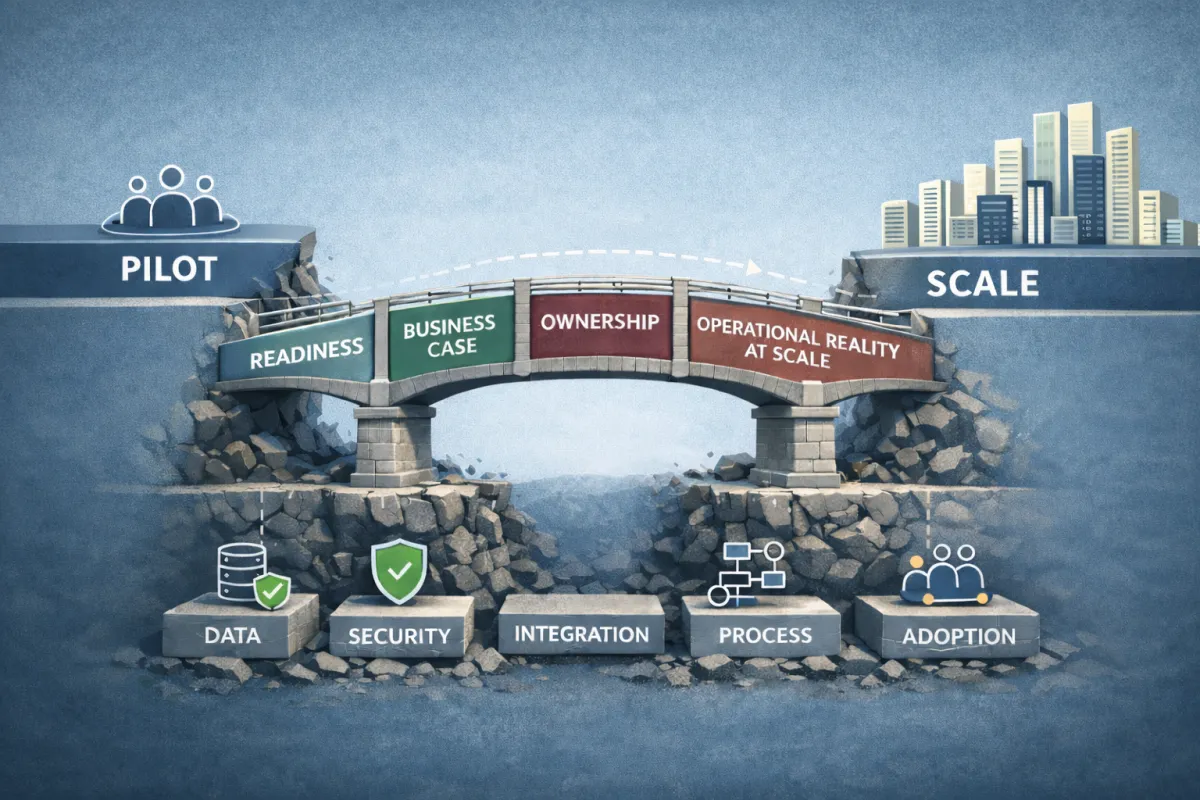
Why Enterprise Pilots Stall Before They Scale
Many pilots do exactly what they were supposed to do. They generate interest, produce encouraging signals, and show that a capability may have real potential.
Then the harder question arrives.
Not whether the tool worked in a limited setting, but whether the business is prepared to support it beyond that setting.
That is where many pilots stall. The problem is often not enthusiasm or even technical promise. It is the missing bridge between a successful test and a workable operating model.
When that bridge is weak, a few familiar warning signs tend to show up:
The pilot lingers longer than expected.
The next phase never quite gets defined.
Stakeholder interest starts to scatter.
The original sponsor gets pulled into something else.
What began as a visible sign of innovation turns into a quiet question mark.
This happens often enough that leaders should treat it as a pattern, not a surprise.
Enterprise pilots rarely stall because the idea was weak. They stall because the path from early promise to operational reality was never clear enough in the first place.
A pilot is not the goal. It is only useful if it helps an organization make a better decision about what to do next.
Before a pilot can scale, leaders usually need to clarify four things:
1. Readiness is not the same as activity
One of the most common mistakes organizations make is treating pilot activity as evidence of broader readiness.
It is not.
A pilot can show that a capability is interesting. It can show that a team is willing to experiment. It can show that a narrow use case has potential. What it cannot do on its own is answer the larger questions that determine whether scale is realistic.
Can the process hold up in an uncontrolled environment?
Will the data support broader use?
Is the operating model ready for what comes next?
Does the business actually want to absorb the change required?
Those questions often arrive late, after enthusiasm has already done the heavy lifting.
2. The business case has to catch up with the use case
Many pilots begin with a reasonable use case but a weak business case.
A team may be able to show that a tool can reduce manual work, improve visibility, or automate part of a workflow. But unless leadership can connect that result to measurable business value, the pilot often remains interesting rather than important.
Interesting projects survive for a while. Important projects get resourced.
That does not mean every pilot needs a perfect ROI model on day one. It does mean leadership should be able to answer a simple question: What should improve in the next 30 to 90 days if this is worth continuing?
If that answer remains vague, scale becomes hard to justify.
3. Ownership gets blurry at exactly the wrong time
Pilots often start with concentrated ownership and end with distributed ambiguity.
At the beginning, there is usually a champion. But as soon as the conversation shifts from testing to scaling, ownership gets more complicated.
Who funds the next phase?
Who governs risk?
Who changes the process?
Who measures results?
Who decides whether to expand, pause, or stop?
If those answers are not clear, the pilot starts to drift between groups. Everyone remains interested, but no one fully owns the transition.
That is where many promising pilots lose altitude. Not because the technology failed, but because the organization never decided who would be responsible for turning a test into operational reality.
4. Scale tests the business, not just the tool
A pilot can succeed while bypassing the very things that make scale difficult. Small groups can move faster. Narrow environments reduce complexity. Friendly users tolerate rough edges. Temporary workarounds feel acceptable because the effort is still being evaluated.
But scale has a way of exposing everything the pilot was allowed to ignore.
Data quality matters more.
Integration becomes harder.
Security and governance move to the center.
Process variation shows up quickly.
User adoption becomes uneven.
This is why a pilot can be genuinely successful and still fail to scale. The organization is no longer testing the idea. It is testing whether the business is ready to support the idea under real conditions.
When a pilot begins to stall, leaders need to evaluate more than the technology itself. They need to ask whether the problem matters, whether success measures are clear, whether there is an accountable owner for scale, and whether the business is prepared to change the way work gets done if the pilot succeeds.
A healthy pilot should help an organization do one of three things:
Move forward with greater confidence.
Pause for specific reasons, or stop with useful lessons in hand.
Reach a clear decision rather than drifting in limbo.
By the time a pilot is underway, most organizations are already asking whether the technology works. The more important question is whether the organization is ready to act on the answer.
When a pilot ends, the next step should be clear: scale, pause, or stop.
That is where pilots either become progress or remain experiments.