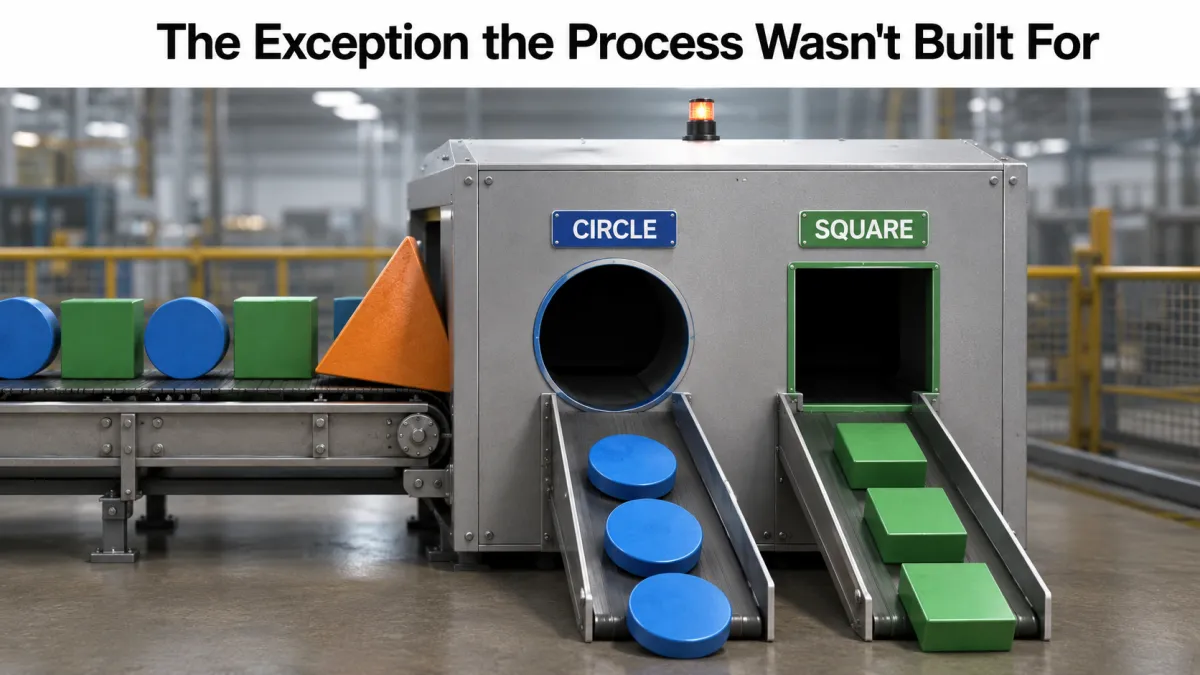
The Exception the Process Wasn't Built For
Most automation strategies are designed around the path leaders expect work to follow.
An order is submitted correctly, a customer record contains the required information, an approval reaches the right person, and the system moves the work forward. Real work does not always cooperate. A customer changes an order after production begins. A record is incomplete. A purchase request exceeds normal authority. An AI agent encounters a request it cannot confidently interpret.
These are exceptions, and they are more common than most leaders realize.
When exceptions aren’t built into the automation strategy, employees become the unofficial recovery system—chasing missing information, sending follow-up emails, building side spreadsheets, and asking managers for one-time decisions. The technology still looks successful because standard transactions keep moving. Behind that efficiency, employees are absorbing the cost of everything the automation was never designed to handle.
Consider a midsize distributor that automated its order-to-cash process end to end. Standard orders cleared in minutes. But when a customer disputed an invoice or a shipment arrived short, the system had no path forward. Three different teams created their own manual fixes, none visible to the others. The dashboard showed a 98% straight-through rate. It didn’t show the 12 hours a week finance spent reconciling the other 2%.
Why This Matters Now
Organizations are expanding automation across customer service, finance, operations, supply chains, and internal workflows. At the same time, AI is increasing the number of decisions systems can make without direct human involvement.
That combination creates real opportunity—and raises the stakes for exception handling. The more work a system controls, the more damaging an unclear exception path becomes.
For example, an AI-enabled service workflow may handle routine requests successfully but fail when a customer asks for something outside policy. The system may not know whether to issue a refund, escalate the case, or request human review.
The problem isn’t that something unexpected happened. It’s that the organization never decided who owns the decision when it does.
This is why exception ownership belongs in the automation strategy itself, not on a list of operational details to solve later.
Where Risk Quietly Builds
In execution: Employees create workarounds to keep exceptions moving. The work gets done, but the organization loses visibility into the effort required and the time being consumed.
In risk: Exceptions often involve the cases with the greatest financial, customer, or regulatory exposure. A disputed invoice, unusual contract term, or conflicting customer record may require judgment no automated workflow can provide.
In governance: Responsibility fragments. IT owns the platform, operations owns the process, and a manager may approve unusual cases. Each owns a piece, but no one owns the exception from beginning to end.
That’s where delays, confusion, and unmanaged work accumulate.
Start Here: Questions to Clarify Before Scaling Automation
What types of exceptions occur most often, and which create the greatest customer, financial, operational, or compliance risk?
Where do employees leave the automated process to complete work manually, and who has authority when the standard rules don’t apply?
How quickly must an exception be identified, assigned, and resolved?
Taken together, these questions reveal whether a process is truly ready to scale or merely ready to move faster under ideal conditions.
Next: What to Put in Place
Start by assigning a clear business owner for exception handling—not simply the person who administers the technology, but someone accountable for how exceptions are identified, routed, resolved, and reviewed.
From there, map the most common and highest-risk exception paths, define escalation rules, and build recovery procedures for incomplete data, failed integrations, and unusual customer or supplier situations.
Then measure exception volume, resolution time, recurring causes, and manual effort. Those measures often reveal more about automation quality than the number of transactions completed successfully.
They should also review them regularly. Are the same exceptions recurring? Are they being resolved inside the approved process? Does each one have a visible owner and status?
Bottom Line
Automation isn’t complete when the standard path works. It’s complete when the organization knows what happens when the work doesn’t follow the plan.
Leaders don’t need to eliminate every exception. They need to stop letting a clean dashboard hide an unmanaged one—and put ownership, visibility, and a clear resolution path in place before exceptions pile up, not after.
That is what separates automation that looks fast from automation that is actually dependable.
Know someone who would find this useful? Feel free to forward this edition.
Thanks for reading,